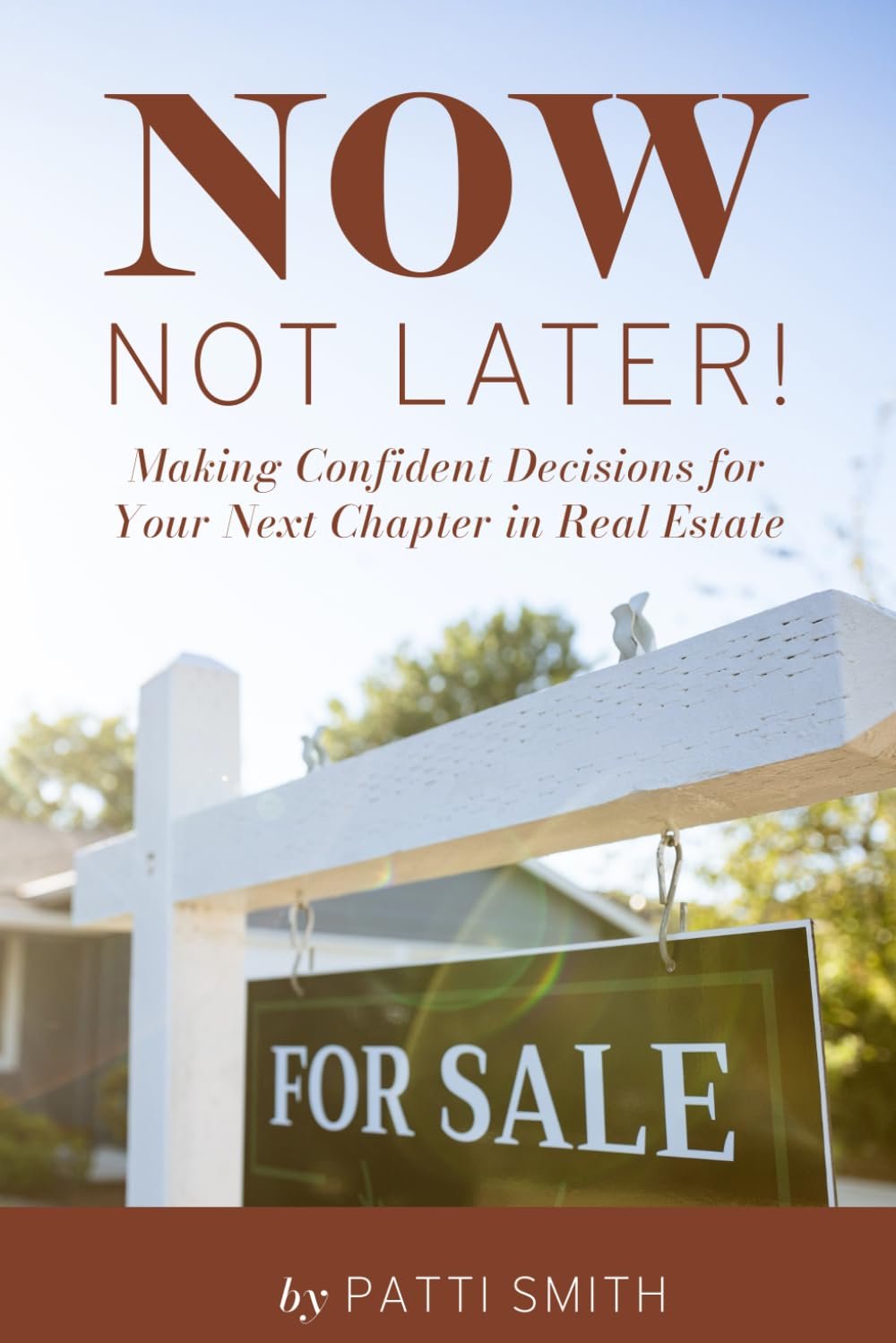
A Decision Guide by Patti Smith Now, Not Later! by Patti Smith, book cover

Now, Not Later!

Making Confident Decisions for Your Next Chapter in Real Estate

Two guides in one book: one for homeowners ready to write their next chapter, one for renters ready to own. Both about deciding with confidence, now, not later.

Two Guides in One Book

Which one are you?

Start with the guide that fits where you are right now. You can read the other one too, but this is the fastest way in.

Buying a home is not just about finding a property. It is about trust, timing, and choices that ripple through your financial and emotional life for years to come. One right decision can create stability, wealth, and memories. One wrong step can quietly cost tens of thousands, delay your dreams, and leave you carrying regret.

That is why I am writing to you on behalf of Patti Smith. I know her. I know how she works. I know how she cares for people in moments just like the one in right now.

You have plenty of choices in your marketplace. You may be speaking with several agents. That is wise. This is your purchase, your family's future, your life's next chapter. But I want to tell you plainly: in Patti Smith, you have someone rare. Someone who understands that explanations create clarity, clarity creates confidence, and confidence creates the outcomes you most want.

This book is proof of that. Patti Smith didn't hand you a glossy flyer. She invested time, energy, and years of hard-won experience to collaborate with me in writing this for you. For decades, I've coached thousands of real estate professionals across North America. I've seen good agents, great agents, and extraordinary agents. Patti Smith stands in that last category.

This book contains two distinct guides, each crafted for different situations you might find yourself in:

The first five chapters are written for homeowners who are ready to make their next move, those who have built equity and are considering how to leverage their position for their next chapter. You'll discover why rate obsession can trap you in the wrong home, how the true cost of space affects your daily life, why proximity to what matters most should guide your decisions, and how to time your life rather than chase market predictions.

The second five chapters speak directly to renters who are ready to break free from the cycle of building someone else's wealth. You'll learn about the rent trap that quietly transfers your money to landlords, why waiting for perfect market timing keeps you renting forever, how inflation erodes your purchasing power while you save, and what lifestyle limitations you're accepting by staying in temporary housing.

Whether you're moving from one home to another or transitioning from renting to owning, these insights reveal the traps that cost buyers their future. You'll understand why chasing perfect conditions rarely works out, how delayed decisions compound into massive opportunity costs, and why the life you're not living while you wait may be more valuable than the money you're trying to save.

This book is not theory. It is practice. It is the voice of thousands of transactions distilled into clear explanations. When you understand, you choose wisely. When you choose wisely, you move forward with confidence and begin building the life you imagined.

I know you don't know me, but for 40 years I've had a front-row seat to the choices agents make and the results those choices create for families. I can say with confidence: Patti Smith is an extraordinary choice. She does not settle for shortcuts or promises. She guides with presence, with patience, and with power.

So as you read, keep this in mind: you have been given more than a book. You have been given a partner who will not let you stumble into the traps that so many buyers fall into. Use the reflection questions. Mark the pages. Let this knowledge sharpen your decisions. Then sit with Patti Smith and let her put it into action for your purchase.

When you do, you will not only buy a home, you will begin your next chapter with confidence, strength, and the peace of knowing you were guided with uncommon care.

With respect, Joe Stumpf Founder, By Referral Only

Inside the Book

Read it here

Pick a guide, then tap any chapter to open it.

Beyond the Numbers: A Guide to Life-Centered Real Estate Decisions

  1. Your home should serve your life, not consume it. Yet many homeowners find themselves trapped in a subtle reversal, spending their prime years managing properties that no longer match how they actually live. The space that once felt like a sanctuary gradually transforms into a burden, demanding time, energy, and resources that could be invested in relationships, experiences, and personal fulfillment.

    The transformation happens slowly, almost imperceptibly. Children move away for college, careers, and families of their own, leaving bedrooms that become repositories for holiday decorations and exercise equipment that seemed essential when purchased. Formal dining rooms that once hosted weekly family dinners now serve as glorified mail-sorting stations. Living areas designed for entertaining house only the evening news and weekend projects. Yards that echoed with children's laughter become weekly obligations, demanding mowing, raking, and maintenance that feels more like duty than joy.

    Without conscious recognition, many homeowners become curators of spaces they don't truly inhabit. They heat and cool rooms they rarely enter, ensure square footage they seldom use, and maintain systems that serve empty spaces. The result is a gradual misalignment between the home's capacity and the owner's actual lifestyle, a gap that grows wider and more expensive with each passing year.

    The Financial Reality of Excess Space

    The financial burden extends far beyond the mortgage payment. Large homes demand proportionally higher costs across every category of ownership. Heating and cooling systems work harder to maintain comfortable temperatures in unused bedrooms and formal spaces. Every additional 1,000 square feet can add $2,000 to $4,000 annually in utility costs, depending on climate and energy efficiency. Property taxes and insurance premiums scale with home size and replacement value. Cleaning services charge by square footage. Even seemingly fixed costs like internet and cable often increase with the number of rooms requiring coverage.

    Maintenance and repair costs follow a similar trajectory. Larger homes have more windows to replace, more roof area to repair, more flooring to refinish, and more mechanical systems to service. The 1-2% annual maintenance rule, often cited as a rough guideline for homeownership costs, can translate to $6,000 to $12,000 yearly for a $600,000 property. But for homes approaching or exceeding twenty years of age, these costs often escalate as multiple systems reach end-of-life simultaneously.

    The compounding effect is significant. Over a ten-year period, the cost differential between maintaining 3,500 square feet versus 2,000 square feet of similar quality can easily reach $60,000 to $120,000. This calculation includes higher utilities, increased maintenance, elevated insurance premiums, and greater property tax assessments. For many homeowners, this represents a substantial portion of their discretionary retirement income, money that could fund travel, experiences, family assistance, or financial security.

    The Hidden Drain on Time and Energy

    Beyond pure financial calculations lies a more subtle but equally important cost: the depletion of personal energy and time. Large homes create what researchers call "cognitive load", the mental effort required to make decisions, manage systems, and coordinate maintenance. Every additional room represents potential projects, seasonal preparations, and ongoing upkeep decisions. The larger the home, the longer the mental to-do list, and the more your attention gets fragmented across property management tasks.

    Consider the hidden time investments that large homes require. Scheduling and coordinating with contractors for routine maintenance. Researching and purchasing replacement items for multiple bathrooms, bedrooms, and living areas. Managing seasonal transitions that affect different zones of the house. Cleaning or supervising the cleaning of spaces you rarely use. These tasks individually seem minor, but collectively they can consume hours each week, time that could be invested in health, relationships, hobbies, or community involvement.

    The physical demands of large home ownership become more apparent with age. Stairs that felt neutral in your fifties can become daily challenges in your seventies. Multiple levels mean multiple areas to secure, monitor, and maintain. Yard work that once provided satisfying exercise can transform into a dangerous obligation as balance and endurance decline. Many homeowners find themselves gradually avoiding portions of their own homes, essentially paying to maintain spaces they've begun to fear or find inaccessible.

    The Emotional Weight of Empty Space

    The emotional toll often proves most surprising to homeowners. Empty bedrooms can trigger memories and melancholy rather than serving any practical purpose. Unused formal spaces can feel like monuments to a life stage that has passed, creating subtle but persistent reminders of what once was rather than supporting what is. Some homeowners describe feeling like caretakers of their own memories, trapped by sentiment in spaces that no longer spark joy or serve their current needs.

    This doesn't mean that staying in a larger home is always wrong. There are legitimate reasons to maintain extra space: regular hosting of family gatherings that genuinely utilize the square footage, multi-generational living arrangements, home-based businesses or serious hobbies that require dedicated space, or simply abundant financial resources that make the cost differential irrelevant. The key is honest assessment, are you maintaining space for active, purposeful use, or out of habit and attachment to past chapters of your life?

    Alternative Solutions to Moving

    The path forward isn't necessarily about moving to a smaller home, though that's often the most straightforward solution. Some homeowners successfully reconfigure their current properties for more efficient living, converting upper levels to rental units or redesigning layouts to concentrate daily activities on a single floor. Others outsource the maintenance tasks that have become burdensome, hiring services for yard work, cleaning, and routine upkeep to eliminate the time and energy drain without changing location.

    Technology can also reduce the burden of larger homes. Smart thermostats can zone heating and cooling to occupied areas. Security systems with cameras and sensors can monitor unused spaces without requiring physical checks. Automated irrigation and lighting systems can maintain landscapes and exteriors with minimal human intervention. While these solutions require upfront investment, they can significantly reduce the ongoing cognitive and physical load of large home ownership.

    Making Informed Space Decisions

    The most successful space optimization begins with honest usage assessment. Track which rooms you actually occupy over a typical month. Note which maintenance tasks consistently drain your energy or enthusiasm. Calculate the true financial cost of space you don't actively use. This data provides the foundation for informed decision-making about whether to modify, maintain, or move from your current situation.

    The goal isn't to judge the choices you made in previous life stages, the large home may have been perfect when children filled bedrooms and social calendars demanded entertaining space. The goal is alignment between your current reality and your living environment. When that alignment exists, your home becomes a platform for the life you want to live. When it doesn't, your home becomes a barrier to that life, consuming resources that could be better invested in experiences, relationships, and personal fulfillment.

    The true cost of space isn't measured only in dollars, though the financial impact is substantial. It's measured in the opportunity cost of time and energy diverted from what matters most to you now. The space you choose to maintain should actively contribute to your current priorities, not simply exist as a monument to previous chapters of your story.

    Chapter 1: The True Cost of Space

    • Which rooms in my home carry energy but no life, and what is it costing me emotionally, financially, and spiritually to maintain them?
    • How would my daily rhythm expand if I released the burden of unused space and chose only what actively nourishes me now?
    • What memories am I holding onto through square footage that could be released in order to create space for who I am becoming?
  2. The headlines scream about interest rates. Dinner conversations revolve around market predictions. Financial news cycles through endless speculation about when rates might drop, when markets might cool, and when the "perfect" moment to buy or sell might arrive. Yet the most important calculation in real estate has nothing to do with percentages or projections, it's the equation between the life you're living and the life you want.

    When homeowners tell me they're waiting for rates to drop from six percent back to three, I understand the impulse. Numbers feel concrete in an uncertain world. A mortgage rate is quantifiable, trackable, something you can point to and say, "This is why we're waiting." But this laser focus on interest rates often obscures a more fundamental truth: for established homeowners with substantial equity, the traditional affordability equation has changed entirely.

    The Equity Advantage

    Consider a homeowner who purchased their home twenty-five years ago for $200,000. Today, that same property might be worth $600,000, with only $150,000 remaining on the mortgage. The equity they've built, through monthly payments, appreciation, and the simple passage of time, totals $450,000. This isn't just a number on a statement; it's accumulated wealth that fundamentally changes their financial options.

    If this homeowner decides to purchase a $500,000 property, they're not starting from zero like a first-time buyer. They can roll their $450,000 in equity forward, borrowing only $50,000 for their new home. At today's six percent interest rate, that monthly payment would be approximately $300. Compare this to a first-time buyer who needs to finance $400,000 of that same property at six percent, their payment jumps to $2,398 monthly. The difference is staggering, and it illustrates why obsessing over interest rates can be misleading for equity-rich homeowners.

    This mathematical reality extends beyond monthly payments. When you have substantial equity, you're essentially insulated from much of the rate sensitivity that dominates media coverage. The portion of your purchase that requires financing may be so small that even significant rate changes have minimal impact on your monthly obligations. A two-point swing in rates might affect your payment by $50 or $100 monthly, meaningful, but not necessarily life-altering when weighed against other factors.

    The Hidden Costs of Waiting

    Yet many homeowners remain anchored to rate comparisons, often missing the broader financial picture. While they wait for rates to improve, they continue paying the full cost of their current home ownership. For a $600,000 property, annual carrying costs typically include property taxes of $10,000 to $15,000, insurance premiums of $2,000 to $4,000, maintenance and repairs averaging 1-2% of the home's value, and utilities ranging from $3,000 to $5,000. These expenses total $20,000 to $30,000 annually, regardless of your mortgage rate.

    Over two years of waiting for better market conditions, these carrying costs alone could reach $40,000 to $60,000. For rates to justify this delay, you'd need them to drop enough to save you more than what you're spending to stand still. Given typical loan amounts for equity-rich homeowners, this break-even scenario often requires rate decreases that may never materialize.

    Breaking Free from Rate Fixation

    The psychological trap of rate fixation runs deeper than mathematics. Homeowners often treat their low-rate mortgage like a trophy, a symbol of smart financial timing. This emotional attachment can prevent clear thinking about whether the home itself still serves their needs. A three percent mortgage rate only benefits you if the house it's attached to supports the life you want to live. If you're maintaining more space than you need, living far from family and friends, or spending weekends on projects you no longer enjoy, that "great" rate might be costing you more than a higher rate on a home that truly fits.

    The market timing mentality assumes you can predict future rate movements with reasonable accuracy. History suggests otherwise. Even professional economists and Federal Reserve officials regularly miss the mark on rate forecasts. Economic conditions, geopolitical events, and policy changes create complexity that defies precise prediction. Basing major life decisions on interest rate speculation is essentially gambling with your remaining years.

    There's also the opportunity cost of delay to consider. Every month you postpone a move that would improve your quality of life is a month you cannot reclaim. If relocating would place you closer to grandchildren, reduce your maintenance burden, or position you near healthcare and community resources you'll increasingly need, waiting for marginal rate improvements trades real lifestyle benefits for hypothetical financial gains.

    Modern Financial Flexibility

    The refinancing safety net provides another angle worth considering. Unlike previous generations who were often locked into their original mortgage terms, today's homeowners retain the option to refinance if rates fall significantly. This flexibility means you don't need to wait for perfect conditions before making a move. You can act based on your current life needs and adjust your financing later if market conditions improve.

    Smart financial planning starts with understanding what actually drives your costs and benefits. For established homeowners, this analysis should include total housing expenses, not just mortgage payments. It should weigh the value of time against the uncertainty of market timing. It should consider your stage of life, health trajectory, and relationship priorities alongside pure financial metrics.

    Redefining Value Beyond Numbers

    The most successful homeowners I work with approach these decisions with what I call "financial pragmatism." They respect the importance of sound money management while recognizing that personal fulfillment and family connection have value that doesn't appear on spreadsheets. They use their equity strategically, not to chase perfect market timing, but to align their housing with their actual priorities.

    This doesn't mean ignoring financial prudence. It means expanding your definition of value beyond interest rates and monthly payments. When you factor in the cost of time, the value of proximity to loved ones, and the benefit of reduced stress and maintenance, the "expensive" move often proves to be the wise investment.

    The mathematics of what matters extends far beyond mortgage calculations. It includes the compound interest of family relationships, the appreciation of personal freedom, and the depreciation of unused time. These variables don't appear in rate charts or market forecasts, but they determine whether your housing decisions create wealth in the truest sense, a life well-lived.

    Chapter 2: The Mathematics of What Matters

    • What would shift in my life if I stopped measuring decisions by percentages and started measuring them by the life I most want to live?
    • How has my attachment to "a good rate" blinded me from seeing the equity, freedom, and possibility I already hold in my hands?
    • What is the true cost of waiting, what relationships, experiences, or peace am I trading for the illusion of a better number?
  3. Where you live shapes who you see, what you do, and how engaged you remain with the world around you. Distance, while seemingly manageable today, has a peculiar way of growing heavier with time. What feels like a reasonable drive in your sixties can become prohibitive in your seventies, transforming manageable geography into insurmountable barriers between you and the people and activities that give your life meaning.

    The mathematics of proximity is often underestimated. A twenty-minute drive to visit grandchildren becomes forty minutes round-trip, plus preparation time, plus the energy required for the journey itself. As these small increments accumulate, what once felt spontaneous becomes planned, what felt easy becomes effortful, and what felt natural becomes increasingly rare. The subtle erosion of connection happens gradually, often without conscious recognition, until one day you realize weeks have passed since you've seen the people who matter most.

    Research consistently demonstrates that social isolation accelerates cognitive decline, increases depression risk, and contributes to earlier mortality. Yet many homeowners inadvertently choose isolation by prioritizing property features over proximity to their support networks. They select homes based on square footage, architectural style, or financial considerations while giving minimal weight to distance from family, friends, healthcare, and community resources. This prioritization made sense during career-building years when work location often dictated housing choices, but it requires reconsideration as life circumstances evolve.

    Family Connections and Life's Timeline

    The family connection represents perhaps the most emotionally significant aspect of geographic decision-making. Grandchildren don't pause their development waiting for ideal visiting conditions. School plays, sports events, birthday parties, and ordinary Tuesday afternoons happen on their timeline, not yours. The grandparent who lives an hour away might attend major events but misses the casual moments that often prove most precious, the impromptu dinner invitation, the after-school pickup, the sick day when extra help is needed.

    I've observed countless families where geographic distance gradually shifts relationships from active participation to periodic visitation. Grandparents become guests in their grandchildren's lives rather than integral participants. Parents feel guilty about the infrequency of visits but struggle with the logistics of regular travel. Children grow accustomed to communicating with distant grandparents through screens rather than embracing them in person. Everyone adapts, but something essential is lost in the translation.

    The friendship network faces similar challenges. Lifelong friends who once gathered weekly for dinners, activities, or simply companionship find themselves scheduling visits like business meetings. Spontaneous connection, the impromptu coffee invitation, the last-minute dinner suggestion, the "I was in the neighborhood" visit, disappears when neighborhoods are separated by significant travel time. Social calendars become more formal and less frequent, gradually reducing the web of relationships that contribute to emotional well-being and practical support.

    Healthcare and Community Access

    Healthcare proximity becomes increasingly critical as medical needs evolve. The specialists you trust, the hospital where your doctors practice, the physical therapy clinic that knows your history, these relationships and resources become more valuable with age. Living far from established healthcare providers often means starting over with new practitioners who lack your medical history and personal understanding. Emergency situations become more complicated when trusted care is distant. Routine appointments require longer travel, making them more burdensome and potentially leading to delayed or skipped care.

    Community involvement, whether through religious organizations, volunteer work, hobby groups, or civic participation, also suffers from distance. The retiree who dreams of mentoring young professionals but lives far from business districts finds fewer opportunities. The lifelong volunteer whose heart belongs to a particular organization gradually reduces involvement when every commitment requires significant travel. The community member whose voice contributed to local decisions finds participation waning when meetings and events feel geographically inconvenient.

    The window for meaningful connection operates on a timeline that doesn't accommodate indefinite delay. Children grow up faster than anticipated. Friends relocate, develop health issues, or pass away. Community organizations evolve or dissolve. Health changes can make travel more difficult or impossible. The years spent living at a distance from your priorities are years of connection and contribution you cannot recover.

    Strategic Proximity Planning

    Yet proximity isn't simply about minimizing distance, it's about creating sustainable patterns of engagement. The goal isn't to live next door to everyone you care about, but to position yourself within a reasonable radius of your most important relationships and activities. This might mean choosing a location that places you within thirty minutes of your children's families, fifteen minutes from your primary care physician, and walking distance from at least one community organization that reflects your values or interests.

    Geographic strategy should also consider transportation realities. Today's easy drive becomes tomorrow's challenging journey as night vision declines, reflexes slow, or confidence in heavy traffic diminishes. The route that feels comfortable now might prove intimidating in five years. Weather conditions that currently represent minor inconvenience could become significant barriers. Planning for these changes while you still have full mobility creates options rather than limitations.

    Technology's Role and Limitations

    Technology offers partial solutions but cannot replace physical presence. Video calls can maintain some connection with distant family members, online communities can provide social interaction, and telemedicine can handle certain healthcare needs. However, these digital alternatives lack the full richness of in-person relationships. They can supplement proximity but cannot substitute for it entirely. The grandmother who watches her grandchild's school play via livestream experiences the event but misses the pre-show excitement, the intermission conversations, and the post-performance celebration.

    The housing market often presents trade-offs between proximity and other desirable features. The perfect home in terms of size, style, and amenities might be located far from your priority network. The community that offers ideal proximity might have limited housing options that match your preferences. These decisions require weighing the relative importance of physical features versus geographic advantages, often concluding that proximity provides longer-term value than additional square footage or architectural details.

    The Investment Value of Connection

    Financial considerations intersect with proximity in complex ways. Living closer to urban centers or established communities often commands premium pricing, but this cost should be evaluated against transportation savings, healthcare convenience, and the intangible value of sustained relationships. The less expensive home that requires an hour's drive to reach family and services might prove more costly when you factor in travel time, vehicle expenses, and the opportunity cost of reduced connection.

    Moving closer to your priority network while you still have the energy and capability to build new community ties proves more successful than waiting until proximity becomes a necessity. Establishing relationships with neighbors, identifying local services, and creating new routines takes time and effort that become more challenging with age. The proactive move allows you to integrate gradually into your chosen community, building the social capital that will support you in later years.

    The geography of connection ultimately reflects your values and priorities. If family relationships rank high in your hierarchy of importance, living near family members deserves serious consideration. If community involvement provides meaning and purpose, proximity to organizations and activities that align with your interests merits weight in your decision-making. If healthcare quality and convenience matter to your peace of mind, distance from trusted providers should factor into your calculations.

    The most successful housing decisions create geography that supports rather than hinders your vision for your remaining years. This might mean trading space for proximity, architectural charm for convenience, or familiar surroundings for strategic location. The goal is alignment between where you live and how you want to live, recognizing that connection and community often prove more valuable than square footage and storage space.

    Chapter 3: The Geography of Connection

    • Who do I most want to share ordinary Tuesdays with, and how far am I living from them right now?
    • How does distance, measured not just in miles but in energy, shape the depth of my relationships?
    • What would it mean for me to choose proximity over property, connection over features, belonging over square footage?
  4. There are two clocks governing your housing decisions: the market clock and your life clock. While watching market conditions is reasonable, your energy, health, and relationships operate on a different timeline, one that doesn't pause for perfect market conditions, wait for ideal interest rates, or accommodate the luxury of indefinite delay.

    The pursuit of optimal market timing often becomes a sophisticated form of procrastination. Homeowners convince themselves they're being prudent by waiting for rates to drop, prices to cool, or inventory to improve, when in reality they may be avoiding the emotional complexity of change itself. Markets provide convenient external factors to blame for inaction, shifting responsibility away from personal decision-making and onto economic forces beyond anyone's control.

    Professional economists, Federal Reserve officials, and market analysts, armed with sophisticated models, extensive data, and full-time research capabilities, regularly miss the mark on predictions about rate movements, price trends, and market timing. If experts with every possible advantage cannot reliably forecast market conditions, individual homeowners have even less chance of successfully timing their moves to coincide with optimal financial windows.

    The Mathematics of Market Timing

    The data on market timing reveals a sobering truth: most people who try to time real estate markets end up worse off than those who make decisions based on personal circumstances and life needs. The homeowner who waits for rates to drop from 6% to 4% might wait years while continuing to pay carrying costs on a property that no longer serves their needs. Even if rates eventually decline, the money spent maintaining the wrong home during the waiting period often exceeds any savings achieved through better financing terms.

    Consider the mathematics of market timing for a typical equity-rich homeowner. If you're spending $25,000 annually in carrying costs on your current home while waiting for a 2% rate improvement, that waiting period needs to save you more than the costs you're accumulating. For someone borrowing only $100,000 on their next home (thanks to substantial equity), a 2% rate difference equals roughly $160 per month in payment savings. At that rate of savings, it would take more than twelve years to recover just one year's worth of carrying costs spent while waiting. The numbers rarely justify the delay.

    Meanwhile, life moves forward regardless of interest rates or home prices. Grandchildren don't postpone growing up because you're waiting for better market conditions. Your energy level doesn't pause its natural decline while you analyze rate forecasts. Health changes don't schedule themselves around optimal real estate timing. Friends and family members don't suspend their own life transitions to accommodate your market-watching strategy.

    The Price of Waiting

    The opportunity cost of delay extends far beyond financial calculations. Every season spent in the wrong home is a season you cannot experience in the right one. The grandparent who waits three years for better market conditions to move closer to family misses three years of school events, three holiday seasons, three summers of swimming lessons, and playground visits. No amount of interest rate savings can purchase those experiences after they've passed.

    Energy and capability follow predictable trajectories that don't correlate with market cycles. The physical and emotional stamina required to research new communities, pack decades of belongings, coordinate moves, and establish new routines typically peaks in your sixties and early seventies. Waiting until your late seventies or eighties to make these transitions often means attempting complex changes when you have less capacity to manage them effectively.

    Health considerations introduce another timing variable that operates independently of market conditions. The homeowner who needs single-level living due to mobility concerns cannot wait for perfect market timing if stairs have become dangerous. The couple dealing with memory issues cannot delay simplifying their living situation until rates improve if complex home maintenance has become overwhelming. Medical realities often demand housing changes on timelines that have nothing to do with economic cycles.

    Life-Centered Decision Making

    The most successful housing transitions happen when homeowners align their moves with their life circumstances rather than external market conditions. This approach recognizes that the "perfect" financial moment may never arrive, while the optimal life moment is happening now. It prioritizes personal well-being, family connection, and lifestyle alignment over hypothetical market gains.

    This doesn't mean ignoring financial considerations entirely. Responsible planning includes understanding current market conditions, evaluating your financial position, and making informed decisions about timing and pricing. However, it means recognizing that life factors often outweigh market factors in determining the right time to move. The goal is financial prudence in service of life satisfaction, not life satisfaction deferred indefinitely in pursuit of financial optimization.

    The concept of "good enough" timing proves more practical than perfect timing. If your financial position is stable, your target market is reasonable, and your life circumstances favor change, current conditions may be good enough to proceed. Waiting for theoretically better conditions often means missing practically workable conditions that exist today.

    Balancing Risks and Reality

    Risk assessment should include both financial and personal factors. While waiting might reduce some financial risks, it often increases personal risks, declining health, reduced capability, limited time with family, or missed opportunities for community involvement. The homeowner who postpones moving to be closer to family might save money on interest but lose irreplaceable years of relationship building with grandchildren.

    Market cycles provide useful context but shouldn't dictate personal decision-making timelines. Real estate markets typically operate in longer cycles than most people anticipate. Interest rates might remain elevated for years rather than months. Price corrections, when they occur, often prove smaller and shorter-lived than buyers hope. Inventory improvements might happen gradually rather than dramatically. Basing major life decisions on assumptions about market timing often leads to years of delay for minimal or nonexistent gains.

    The refinancing option provides important flexibility that previous generations of homeowners didn't enjoy. Unlike the past, when mortgage terms were largely fixed for the life of the loan, today's homeowners can adjust their financing if market conditions improve significantly. This safety net means you don't need to wait for perfect conditions before making a move. You can act based on current life needs and modify your financing later if opportunities arise.

    Personal Readiness Over Market Perfection

    Successful timing strategies focus on personal readiness rather than market perfection. They ask questions like: Do we have the energy to manage a transition? Are our life circumstances stable enough to handle change? Do we have clarity about what we want in our next chapter? These factors matter more than whether rates might drop six months from now or whether prices might soften next year.

    The most important timing consideration is often your life clock rather than the market clock. When your current home no longer supports the life you want, when distance keeps you from people you love, when maintenance demands exceed your interest in managing them, when health or energy concerns suggest simplification, these signals matter more than any economic indicator.

    Your life clock is more reliable than any market forecast because it's based on realities you can observe and control rather than predictions about complex systems that nobody fully understands. When you honor your life timing while being reasonably informed about market conditions, you make decisions that serve both your financial security and your personal fulfillment.

    The goal isn't perfect timing, it's purposeful timing that aligns your housing situation with your life priorities while you still have the capability and energy to create the changes you want. This approach leads to decisions you can feel confident about, regardless of how markets evolve, because they're based on serving your life rather than speculating about economic trends.

    Chapter 4: Timing Life, Not Markets

    • Where in my life am I hiding behind the excuse of "better timing" instead of honoring the truth of my life's clock?
    • How would my decision-making change if I trusted that my energy, health, and relationships matter more than market predictions?
    • What opportunities have I already lost by waiting, and what opportunities could I reclaim if I acted now?
  5. At its heart, a home is not an investment thesis, a collection of systems to maintain, or a repository for memories of past chapters. It's the stage where your life unfolds, the environment that either amplifies or constrains your daily experiences, and the foundation from which you build your remaining years. The decision to stay or move ultimately comes down to this fundamental question: where do you want to write your next chapter?

    Every life contains multiple chapters, each requiring different settings to reach its full potential. The chapter of raising children benefits from space, good schools, and room for growth. The career-building chapter might prioritize location, commute convenience, and entertaining space for professional networking. The early retirement chapter often calls for different priorities entirely, proximity to family, simplified maintenance, access to healthcare, and alignment with your evolved interests and capabilities.

    The trap many homeowners encounter is attempting to write their current chapter in the setting designed for a previous one. They cling to family homes after families have grown and scattered, maintaining large properties when their interests have shifted toward travel and experiences, staying in locations that served working years but isolate them in retirement. This misalignment between life stage and living environment creates friction that touches every aspect of daily experience.

    Deploying Your Equity Strategically

    Your home should amplify your life, not constrain it. When the setting matches the story you're trying to tell, daily routines flow smoothly, relationships flourish, and new opportunities feel accessible rather than burdensome. When the setting works against your current priorities, simple tasks become complicated, connections require more effort, and possibilities feel limited by logistics and maintenance obligations.

    The equity you've built over decades represents more than numbers on financial statements, it's stored potential, accumulated freedom that can be deployed strategically to support your vision for your remaining years. This resource can purchase proximity to grandchildren, freedom from yard work responsibilities, peace of mind that comes from simplified living, or financial flexibility to support experiences you've deferred during busier life stages.

    Some homeowners discover that their next chapter requires less space but more convenience. They trade square footage for single-level living, exchange large yards for professionally maintained landscapes, and substitute formal rooms they rarely use for open concepts that facilitate daily living. The goal isn't downsizing for its own sake, it's right-sizing to match current realities and future projections.

    Geographic Considerations for New Chapters

    Others find that their next chapter demands a different geography entirely. The career that kept them in a particular region for decades may no longer anchor their location decisions. Children scattered across the country create a pull toward different areas. Health considerations might favor different climates or elevation levels. Community involvement opportunities might be richer in areas they previously couldn't consider due to work obligations.

    The process of envisioning your next chapter requires an honest assessment of your current situation and a thoughtful projection of your likely trajectory. Consider your energy levels, health trends, relationship priorities, and sources of meaning and engagement. Ask yourself what activities and connections you want to prioritize in your remaining years, then evaluate how well your current environment supports those priorities.

    Financial considerations should inform but not dominate this analysis. The goal is sustainable affordability that supports your lifestyle vision, not maximum cost-cutting that constrains your possibilities. The homeowner who moves to a less expensive area but finds themselves isolated from family and community may save money while impoverishing their daily experience. Conversely, investing in proximity to loved ones or preferred activities often proves worthwhile even if it requires higher housing costs.

    The Importance of Proactive Timing

    The timing of chapter transitions matters significantly. Making changes while you have full energy and choice typically produces better outcomes than waiting until circumstances force hasty decisions. The proactive move allows time to research communities thoroughly, build new relationships gradually, and establish routines while you still have the capability to manage complex transitions.

    Community building becomes particularly important when writing new chapters in different locations. The social connections, service relationships, and activity networks that developed naturally over decades in your previous location require intentional cultivation in new environments. This process takes time and energy, making it more manageable when undertaken from a position of strength rather than during periods of health decline or family crisis.

    Healthcare continuity represents another crucial consideration in chapter planning. Establishing relationships with new physicians, specialists, and healthcare systems while you're healthy proves much easier than making these connections during medical emergencies. The quality and accessibility of healthcare in your chosen area should factor heavily into location decisions, particularly as medical needs typically increase with age.

    Managing Family and Relationship Dynamics

    Family dynamics often complicate chapter planning in unexpected ways. Adult children may have conflicting opinions about your housing decisions, some favoring proximity while others advocate for financial conservation. Grandchildren's activities and school schedules might influence timing considerations. Aging parents or siblings might need increasing support, which affects your geographic flexibility. Balancing these competing priorities requires clear communication about your own needs and boundaries.

    The role of possessions in chapter transitions deserves particular attention. Decades of accumulation often feel overwhelming when contemplating change, leading some homeowners to postpone moves rather than face sorting through belongings. However, the process of downsizing possessions can prove surprisingly liberating, eliminating items that no longer serve your current life while highlighting what truly matters. Professional organizers and estate sale companies can facilitate this process, transforming what feels like a burden into manageable transition steps.

    Technology and Financial Planning

    Technology can support chapter transitions in various ways while also creating new considerations. Smart home systems can simplify property management in any location. Video calling can maintain distant relationships while you prioritize proximity to others. Online communities can provide social connections when physical mobility becomes limited. However, technology cannot substitute entirely for physical presence and geographic convenience, it can supplement but not replace strategic location decisions.

    Financial planning for chapter transitions should encompass both immediate transition costs and long-term sustainability. Moving expenses, temporary housing costs, and setup expenses for new locations can be substantial but are typically one-time investments. The ongoing costs of your chosen lifestyle, housing, healthcare, transportation, and activities, should align with your projected income and assets throughout your remaining years.

    Embracing Change as Growth

    The emotional aspects of chapter transitions often prove more challenging than practical considerations. Leaving a home filled with memories can feel like abandoning your history. Starting over in a new community might seem daunting after decades of established routines. These feelings are normal and valid, but they shouldn't prevent decisions that serve your future well-being. Your memories travel with you, and your history remains part of your story regardless of your address.

    Success in chapter transitions often depends on viewing change as addition rather than subtraction. Instead of focusing on what you're leaving behind, emphasize what you're gaining access to, more time with family, reduced maintenance obligations, new community connections, different recreational opportunities, or improved healthcare access. This perspective shift can transform what feels like loss into an exciting new beginning.

    The most fulfilling next chapters often surprise their authors. The grandparent who moves to a senior community expecting only simplified living discovers unexpected friendships and activities. The retiree who relocates to be near children finds new volunteer opportunities that provide fresh purpose. The couple who downsizes for convenience develops a deeper connection when household management no longer dominates their time together.

    Taking Action on Your Vision

    Your next chapter is waiting to be written, but it won't write itself. It requires intentional decisions about where and how you want to live, what relationships and activities you want to prioritize, and what legacy you want to create through your remaining years. The equity, experience, and wisdom you've accumulated provide the resources to craft this chapter thoughtfully rather than letting it happen by default.

    The only question is whether you'll write it in a setting that serves the story you want to tell, or whether you'll attempt to force a new story into an old setting that no longer fits. Your future self will thank you for having the courage to align your environment with your aspirations, creating the foundation for years filled with connection, purpose, and satisfaction rather than compromise and regret.

    Chapter 5: Writing Your Next Chapter

    • If my home is the stage for my life, does the set match the story I long to live in this season?
    • What dreams, relationships, and freedoms could my equity be redeployed to make possible right now?
    • What courage would it take to stop forcing a new story into an old setting and instead create a home aligned with my becoming?
Patti Smith, Patti Smith Real Estate
About the Author

Patti Smith

Patti Smith is an independent broker and the managing broker of Patti Smith Real Estate, a family-founded brokerage in Georgetown, California. She has guided buyers and sellers across El Dorado County since 1992, and she wrote Now, Not Later! for the people sitting on a decision, waiting for a moment that never quite arrives.

Patti Smith Real Estate · Since 1992 · CA DRE #01110483 · Georgetown, California

Five-Star Client Reviews

Decisions made with a steady hand

This isn't hyperbole when I say Patti Smith Real Estate is the best real estate company on the Divide. We wanted a slower pace of life, and were familiar with Georgetown due to many visits on the way to the Rubicon. When we started looking at houses, Patti's knowledge was incredible. It's another non-exaggeration when Patti would say, I sold this house 10 years ago, or I know the owner of this house and he moved away, do you want me to see if he wants to sell, or did you look at this house, the owners are motivated. Well, we bought the last one of those statements. I've bought and sold many houses, but I've never had a realtor that knew so much about neighborhoods, trades folks to use, where to do this, who could do that, than Patti and team.

Ken Hower

Patti was so helpful in the selling of my house. The whole process was so confusing to me but she made it easier to understand. She came with every offer with my best interest in my mind. She wasn't in a hurry, kept advising me to wait for the right offer. We got over asking and it was a great transaction.

Joshua Varozza

There are so many realtors out there, and most of them don't know their elbow from their heel. Patti Smith is NOT one of those realtors. It has been a very, very good experience working with Patti. She is very engaged and dedicated to MY needs. 100% recommend.

Tevilla Riddell
Questions Readers Ask

Good to know

It is two guides in one book: Book One, for homeowners weighing their next move, and Book Two, for renters deciding whether to buy. Both help you make confident, life-centered real estate decisions rather than waiting for a market that never feels perfect.

Homeowners thinking about their next chapter and renters who are ready to stop renting and start owning. Patti Smith wrote it for anyone in El Dorado County trying to decide whether now is the right time.

Yes. Patti is an independent broker who has represented buyers and sellers across El Dorado County since 1992 (CA DRE #01110483).

Call or text Patti at (530) 368-0852, or reach her by email. You can also search current listings at pattismithrealestate.net.

More from Patti Smith's Library

The rest of the library

Each book stands on its own, and together they cover the whole journey of buying and selling in El Dorado County.

Navigating Transactional Turbulence book cover

Navigating Transactional Turbulence

The 116 kinds of turbulence that can throw a real estate deal off course, and how a steady consultant guides you through.

Your Real Estate Consultant & Broker book cover

Your Real Estate Consultant & Broker

Meet Patti Smith, your independent El Dorado County real estate consultant and broker, and the relationship-first way she works.

The Hidden Costs of Overpricing book cover

The Hidden Costs of Overpricing

Twenty ways sellers lose money without knowing it, and how to price an El Dorado County home to actually sell.

Probate Real Estate book cover

Probate Real Estate Coming soon

Selling a home through probate in El Dorado County, with a steady hand through a hard season.

Get in Touch

Ready to decide? Talk with Patti.

Email copied to clipboard